Last updated: October 29, 2026
Commercial Construction vs. Residential: What’s Different in Southwest Florida?
When property owners in Southwest Florida decide to build, they often assume construction is construction same process, same timeline, same challenges. Nothing could be further from the truth. Understanding the distinctions between commercial construction vs. residential construction could be the difference between a successful project and a costly nightmare.
Commercial construction southwest florida operates under a completely different framework than residential projects, from permitting and regulations to budgeting and team composition. Whether you’re a business owner planning a new retail space in Fort Myers, a developer considering a multi-unit project in Naples, or a property manager overseeing tenant improvements, grasping these critical differences will save you time, money, and significant headaches.
In this comprehensive guide, we’ll explore what separates commercial vs residential construction differences, why these distinctions matter in Southwest Florida’s unique climate and regulatory environment, and how to navigate each path successfully. By the end, you’ll know exactly what to expect and who to call when you’re ready to build.
Understanding the Fundamental Differences Between Commercial and Residential Construction
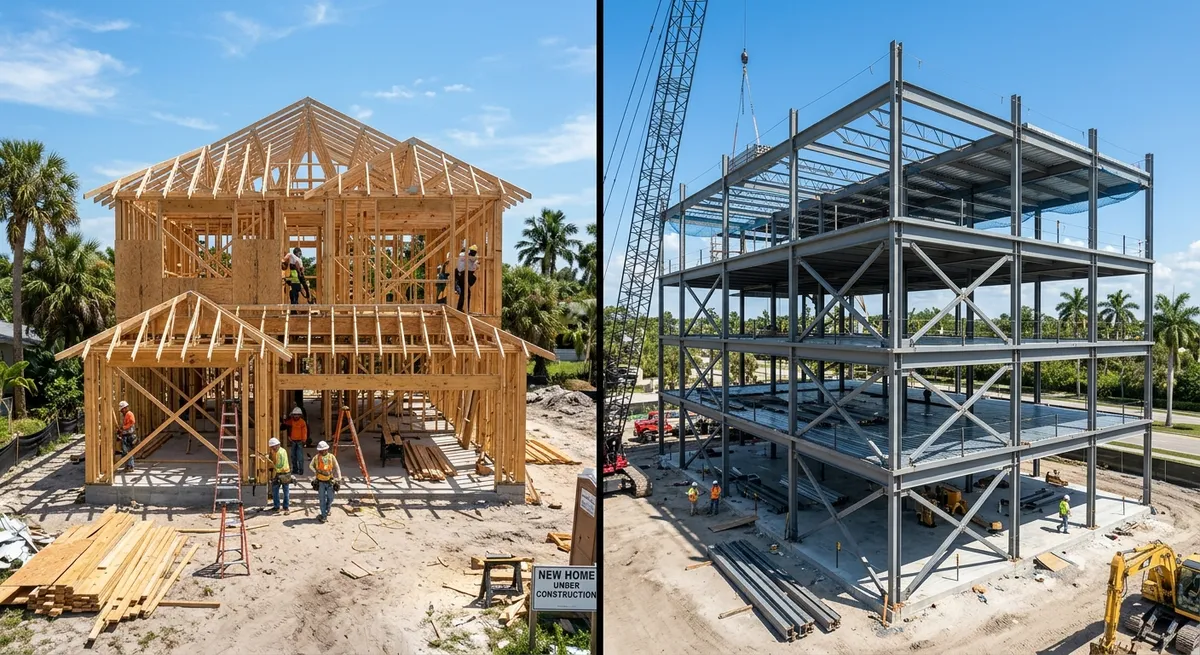
Commercial construction and residential building projects operate under distinct regulatory, financial, and operational frameworks that go far beyond surface-level distinctions. These aren’t minor variations they represent fundamentally different approaches to design, permitting, execution, and project management that affect every aspect of your project. In Southwest Florida, where both industries thrive alongside one another, understanding these differences is absolutely essential for anyone planning a construction project of any scale.
The most immediate distinction lies in building codes and regulations. Commercial buildings must comply with the International Building Code (IBC) and Florida Building Code commercial provisions, which impose far stricter requirements than residential codes. Commercial structures demand more comprehensive fire safety systems, advanced HVAC configurations, specialized electrical infrastructure, and complex plumbing systems designed for high-volume usage. The International Building Code establishes minimum safety standards that vary significantly based on occupancy classification, building height, and area.
Residential construction, by contrast, follows the International Residential Code (IRC), which provides streamlined requirements for single-family and multi-family dwellings up to four stories. While residential projects still must meet hurricane-resistant standards in Southwest Florida a critical consideration given our coastal location the compliance pathway is considerably more straightforward than commercial projects. This simplified regulatory approach allows residential contractors to move faster and maintain more predictable timelines.
Budget and Cost Structures
Commercial projects typically require substantially larger capital investments upfront with far more complex cost distributions. A commercial building contractor in Fort Myers might manage a project with a budget ranging from $500,000 to several million dollars, with costs distributed across land acquisition, extensive site preparation, complex foundation systems, specialized mechanical systems, and sophisticated finishes that reflect brand identity and tenant requirements.
Residential construction in Southwest Florida generally operates within smaller per-unit budgets, though total project costs vary dramatically based on customization level and location. A custom home might range from $400,000 to $2 million depending on square footage and finishes, while commercial spaces often cost $100-$300+ per square foot to construct, compared to $150-$250 per square foot for residential. Understanding these cost structures helps you budget appropriately and select contractors experienced with your project type’s financial parameters.
Regulatory and Permitting Complexity in Commercial Building
This is where commercial construction southwest florida significantly diverges from residential projects in practical terms. Commercial buildings require extensive permitting processes that can take weeks or months, compared to residential permits that typically process within days or a few weeks. A commercial building contractor in Fort Myers must navigate multiple approval layers: building permits, fire department reviews, environmental assessments, ADA compliance reviews, and sometimes specialized permits for specific uses like restaurants or medical facilities.
In Southwest Florida, commercial projects also face unique regulatory requirements related to our coastal environment that fundamentally shape project feasibility and costs. The Coastal Construction Control Line (CCCL) may restrict development in certain areas, potentially eliminating options or forcing design modifications. Stormwater management requirements are more stringent for commercial properties, which typically have larger impervious surfaces than residential homes. Environmental impact assessments become necessary for larger commercial developments, particularly those affecting wetlands or wildlife habitats. These assessments can require months of study and add substantial costs to your budget.
The permitting timeline for a commercial remodel southwest florida can easily extend 2-4 months before construction even begins, whereas a residential kitchen or bathroom renovation might require permits that process in 1-2 weeks. This extended timeline directly impacts project scheduling, financing timelines, and when tenants can occupy space. Building these realistic timelines into your planning prevents frustration and helps coordinate with your business operations.
ADA and Accessibility Requirements
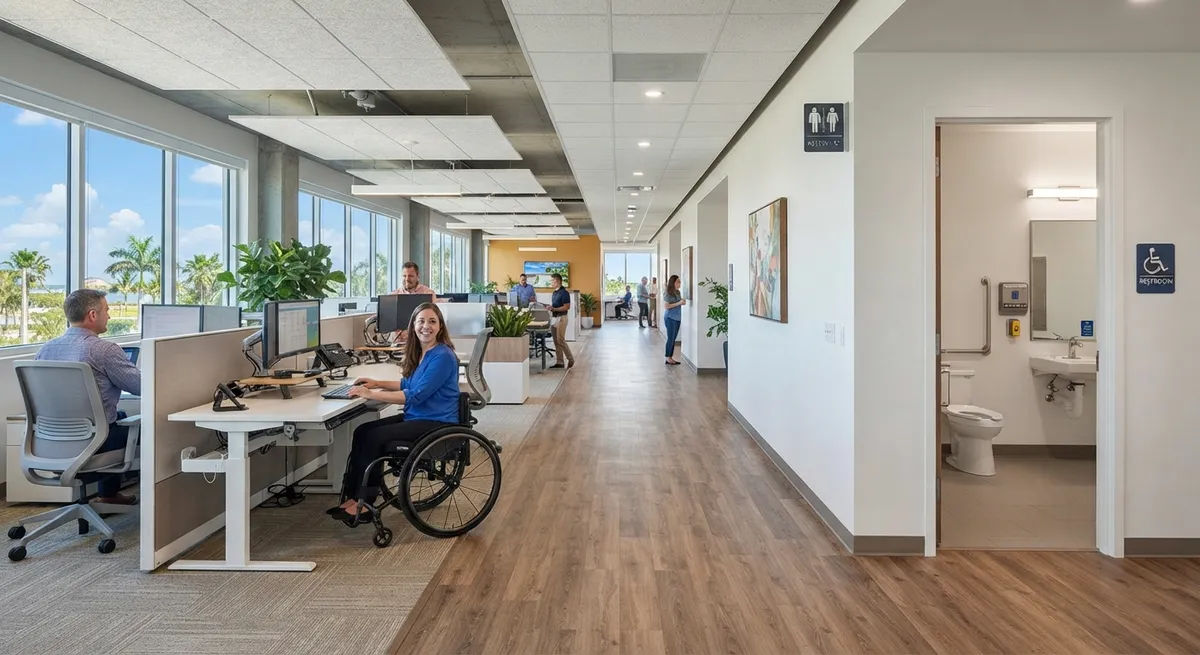
Commercial buildings must fully comply with the Americans with Disabilities Act (ADA), requiring wheelchair-accessible entrances, accessible restrooms, parking accommodations, and interior circulation spaces that meet specific dimensional standards. Every detail from door widths to counter heights to accessible parking space dimensions is regulated and subject to inspection. The U.S. Department of Justice enforces ADA compliance through regular inspections and can impose substantial fines for violations, making this compliance non-negotiable.
Residential construction has fewer ADA requirements for single-family homes, though multi-family residential buildings must provide accessible units and common areas. This distinction creates dramatically different design and construction complexity between commercial and residential projects. A commercial building contractor in Fort Myers must integrate accessibility considerations throughout every design phase, whereas residential projects particularly single-family homes offer more flexibility in accommodation strategies.
Timeline, Scheduling, and Project Management Differences
Commercial construction projects operate on compressed schedules driven by business imperatives that create constant pressure for efficiency. Tenants need space on specific dates to generate revenue. Retail locations must open before holiday shopping seasons to capture peak sales periods. Office tenants have moving deadlines tied to lease commencement dates. These constraints create a fundamentally different pressure environment than residential projects, where delays might be inconvenient but rarely create direct financial losses.
A typical commercial build-out in Southwest Florida might run 4-8 months from permit approval to occupancy, depending on complexity and system requirements. This compressed timeline requires sophisticated project scheduling, daily coordination between multiple trades, rapid problem-solving, and experienced contractors who can anticipate issues before they become delays. Residential projects often allow more flexibility if a custom home takes an extra month, the homeowner can typically adjust their timeline without business consequences. This fundamental difference affects everything from material procurement strategies to staffing decisions.
Commercial contractors in Fort Myers must also manage more complex coordination between specialized trades. While a residential project might involve carpentry, electrical, plumbing, and HVAC, commercial projects add fire suppression systems, security systems, low-voltage infrastructure, commercial kitchen equipment installation, access control systems, and specialized mechanical systems that require precise sequencing and coordination. The interaction between these systems demands constant attention and experienced project management.
Contingency Planning and Risk Management
Commercial projects require more sophisticated contingency planning because delays carry direct financial consequences that extend beyond construction. A 30-day delay in commercial space opening can cost a tenant thousands in lost revenue, force them to operate from temporary locations at additional expense, or create business disruption. This creates pressure for premium pricing, faster material procurement, and potentially increased staffing to maintain schedules. Contractors must invest in advanced planning, detailed risk assessment, and contingency strategies.
Residential projects generally operate with more reasonable contingency buffers, as delays while inconvenient and frustrating don’t typically create ongoing financial losses for the homeowner. This allows residential contractors more flexibility in sequencing and problem-solving without the same time pressure that characterizes commercial work.
Design and Construction Specifications
Commercial buildings demand sophisticated design that balances aesthetics, functionality, durability, and long-term maintenance costs through a lens of business performance. A retail location must be designed to attract customers and facilitate high-traffic flow while reducing maintenance costs. An office building must accommodate numerous tenants with different spatial requirements while maintaining common area efficiency. A warehouse requires specific clearances, loading capabilities, and material handling infrastructure. These competing requirements create design complexity that residential projects rarely encounter.
These design requirements translate directly into more complex construction specifications that govern every material and installation method. Commercial finishes are selected partly for durability metrics that support thousands of daily footsteps or interactions. Wall finishes must be easy to maintain and repair when inevitable wear occurs. Lighting systems must provide appropriate illumination for specific tasks while managing energy costs across the entire facility. Color selections might be based on psychological research about customer behavior rather than personal preference. These specification-driven decisions characterize commercial building across all project types.
Residential construction prioritizes aesthetics and personal preference more heavily, allowing homeowners to guide design selections toward emotional resonance rather than purely functional metrics. While residential builders still emphasize quality, the design process is typically more personal and less constrained by commercial performance specifications. A homeowner might select a specific tile color because they love how it looks, whereas a commercial designer selects based on traffic patterns, maintenance requirements, and lifecycle costs.
Mechanical, Electrical, and Plumbing (MEP) Systems
This is perhaps the most technically complex difference between commercial and residential construction. Commercial buildings require sophisticated MEP systems designed by licensed engineers with specialized expertise. HVAC systems must handle occupancy loads (dozens or hundreds of people generating heat and consuming oxygen), maintain indoor air quality standards that may exceed health codes, and often include zone control for different tenant spaces requiring different conditions. Electrical systems must support equipment loads that residential systems never encounter, maintain emergency backup power capability, and provide dedicated circuits for specialized equipment. Plumbing systems must accommodate high-volume fixtures and may include specialized equipment like commercial kitchens, lab facilities, or medical equipment requiring specific water quality and pressure.
Residential MEP systems are standardized and considerably simpler by comparison. A home’s HVAC system serves one family with predictable occupancy levels; electrical service is sized for typical residential appliances and devices; plumbing follows straightforward patterns based on bathroom and kitchen fixtures. While residential projects still require licensed professionals to design and install these systems, the design and installation process involves far fewer variables and exceptions than commercial systems. A residential electrician works within well-established patterns; a commercial electrician must solve complex problems involving loads, redundancy, and integration with building management systems.
For commercial building contractors in Fort Myers, MEP coordination consumes enormous time and attention throughout the project lifecycle. These systems must be designed to integrate seamlessly, installed in the correct sequence (often requiring specialized access), and tested thoroughly before occupancy. A problem with any MEP system can halt an entire project and delay opening, creating financial consequences for tenants and developers. Commercial contractors must employ or contract with MEP specialists who understand complex system interactions and can solve problems efficiently.
Specialized Considerations for Southwest Florida Commercial Construction
Southwest Florida’s geographic, climatic, and regulatory environment creates unique challenges for commercial construction that contractors must understand deeply. Our coastal location, hurricane season, and environmental restrictions demand specialized expertise from contractors familiar with regional conditions and their implications. Commercial build-out and tenant improvement projects in Southwest Florida require this specialized knowledge to navigate successfully.
Hurricane-Resistant Design and Construction
Commercial buildings in Southwest Florida must meet or exceed Florida Building Code requirements for wind resistance, which are among the most stringent in the nation. Commercial structures typically reach higher elevations than residential homes, exposing them to greater wind loads with exponentially increasing force. Roof systems must be engineered specifically for sustained hurricane-force winds that will test structural integrity repeatedly. Window and door systems must withstand extreme pressure differentials without failure. Exterior walls must be reinforced to resist wind-driven rain penetration that can destroy interior spaces.
These requirements increase commercial construction costs substantially compared to regions without hurricane exposure, representing a permanent cost premium. A commercial building contractor in Fort Myers budgets significant resources for hurricane-resistant engineering, testing, and specialized materials that may cost 20-30% more than standard alternatives. FEMA data shows commercial structures represent critical infrastructure during hurricanes, which is why building codes impose such rigorous standards. Contractors must work with structural engineers familiar with hurricane dynamics and testing protocols required by Florida Building Code.
While residential construction must also meet hurricane resistance standards in Southwest Florida, commercial buildings face even more stringent requirements due to their size, height, and importance to community resilience. A residential home might withstand category 4 hurricanes; a commercial building must be engineered for category 5 conditions with margin for uncertainty. This represents a fundamental difference in design philosophy and required engineering expertise.
Environmental and Wetland Considerations
Southwest Florida’s natural environment with extensive wetlands, mangrove forests, and sensitive ecosystems throughout the region creates additional regulatory requirements for commercial projects that can make or break project feasibility. Larger commercial developments often require environmental impact assessments that document baseline conditions and potential effects, wetland delineation studies that determine protected areas, and compliance with Florida Department of Environmental Protection regulations that govern development in sensitive areas. These requirements can significantly extend timelines and increase project costs, sometimes by hundreds of thousands of dollars.
Residential projects sometimes trigger environmental reviews for larger developments, but commercial projects, particularly those involving significant site disturbance or wetland impacts, almost always require comprehensive environmental compliance. This specialized expertise is essential when selecting a commercial building contractor in Fort Myers, as contractors without environmental experience can underestimate costs and timelines dramatically. Understanding wetland regulations, environmental permitting timelines, and mitigation requirements before committing to a property location prevents serious project complications.
Cost Comparison: Commercial vs. Residential Construction in Southwest Florida
Understanding construction costs requires recognizing that commercial and residential projects operate under different pricing models that affect total project investment significantly. Commercial construction typically uses value engineering systematically analyzing every component to optimize cost, quality, and performance simultaneously. Residential construction more often emphasizes individual preferences and aesthetic choices, which can drive costs in different directions than commercial optimization approaches. These different philosophies create different cost structures and budget variables.
Typical Cost Ranges
A commercial remodel southwest florida generally runs $100-$250 per square foot, depending on finishes and systems complexity. A basic office space might cost $100-$150 per square foot with standard finishes and systems; a specialized retail environment or medical facility might reach $200-$300+ per square foot due to specific requirements and higher durability standards. These costs include all construction labor, materials, and general contractor overhead but typically don’t include land acquisition or architectural fees, which can add 10-15% to total project costs.
Residential construction in Southwest Florida typically ranges $150-$250 per square foot for standard custom homes, with luxury homes reaching $300+ per square foot. A 3,000-square-foot home might cost $450,000-$750,000, whereas a 3,000-square-foot commercial office space might cost $300,000-$450,000. However, commercial projects often require more sophisticated systems, which can reverse this relationship for complex facilities like medical offices or specialized research spaces. According to Statista’s 2026 construction industry analysis, commercial construction costs have increased 6-8% annually, driven partly by material costs and labor availability, with residential costs showing similar increases though market dynamics differ in each sector.
Hidden Costs and Budget Considerations
Commercial projects often encounter hidden costs related to site conditions discovered during construction, environmental factors requiring mitigation, or code compliance issues identified during inspections. Soft costs including architecture, engineering, permitting, testing, and inspections typically consume 15-25% of commercial project budgets, representing a substantial portion of total investment. Residential projects generally see soft costs at 10-15% of total budgets, significantly lower as a percentage. Understanding these percentages helps you budget realistically for your project type.
For commercial building contractors in Fort Myers, accurate budgeting requires extensive experience managing hidden costs and maintaining contingency reserves (typically 5-10% of the project budget for commercial work, compared to 3-5% for residential). Experienced commercial contractors build these contingencies into their bids explicitly, whereas inexperienced contractors might underestimate and create budget crises during construction.
Selecting the Right Contractor: Commercial vs. Residential Expertise
Perhaps the most critical difference between commercial and residential construction involves selecting appropriate contractors with relevant expertise. Many builders specialize exclusively in either commercial or residential work because the expertise required differs substantially in meaningful ways. A local Southwest Florida home builder familiar with custom residential construction might lack the specialized knowledge required for commercial projects, and vice versa. Selecting the wrong contractor type sets your project up for difficulties.
Commercial building contractors in Fort Myers require specific credentials, experience, and capabilities that go beyond basic construction knowledge:
- Demonstrated experience managing projects of similar scope and complexity with verifiable track records
- Bonding and insurance limits appropriate for commercial work (often requiring $1-5 million in coverage)
- Established relationships with commercial subcontractors and suppliers who understand commercial timelines
- Experience navigating commercial permitting and regulatory processes specific to Southwest Florida
- Project management systems designed for complex, multi-trade coordination across extended timelines
- References from commercial clients who can verify on-time, on-budget performance and problem-solving
When evaluating commercial building contractors, request detailed information about their experience with similar project types and specific buildings they’ve completed. Ask how they manage timelines with multiple tenants or stakeholders, communicate with various parties, and handle budget contingencies when issues arise. Request interviews with previous commercial clients who can discuss their experience honestly, including challenges encountered and how the contractor resolved them.
Residential contractors, conversely, should demonstrate expertise in custom home building, understanding homeowner communication preferences, managing personalized design choices, and delivering quality finishes that meet residential aesthetic standards. The skill sets differ fundamentally, and choosing a contractor experienced with your project type prevents frustration and improves results.
Project Timelines: What to Expect
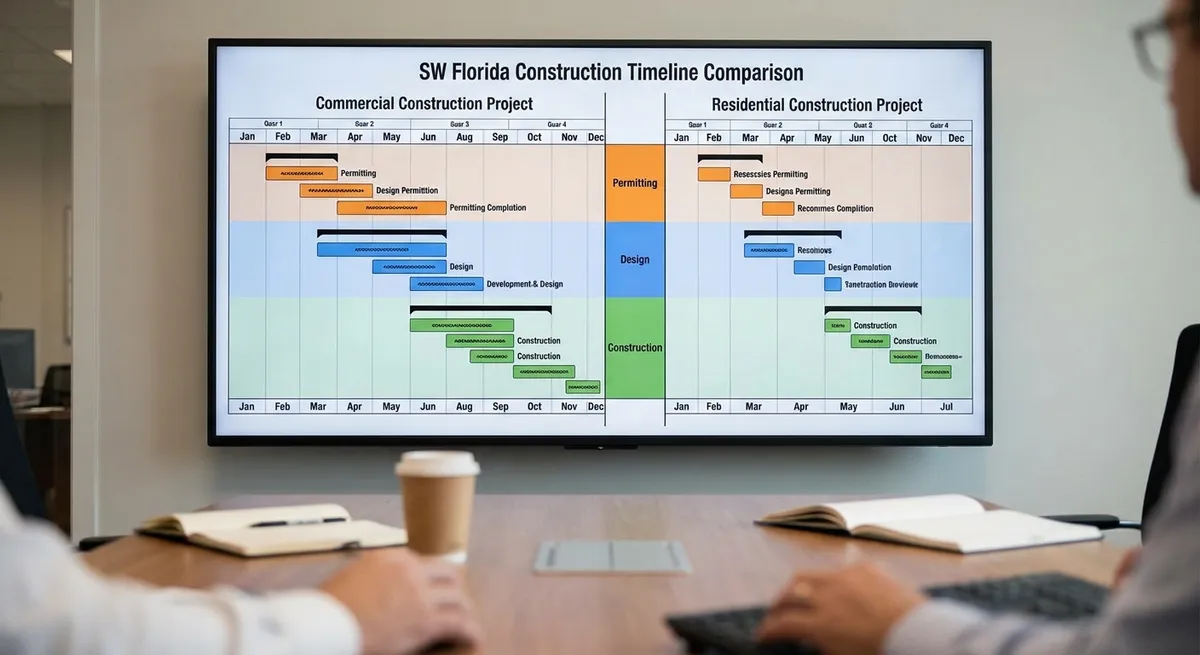
Commercial construction southwest florida projects follow different timeline progression than residential work due to regulatory complexity and system requirements. A typical commercial project includes distinct phases that must occur sequentially:
- Design and planning (2-4 months): Architect and engineers develop comprehensive plans; multiple design reviews and revisions occur as systems are coordinated; specialized engineers (MEP, structural, civil) contribute expertise
- Permitting (2-4 months): Plans are submitted to multiple departments; fire marshal, building official, and environmental reviewers provide feedback; revisions are made and resubmitted; approvals are received incrementally
- Bidding and contracting (1-2 months): Competitive bids are obtained from contractors; contractor selection and contracts are finalized; bonding and insurance are verified
- Construction (4-12 months): Physical construction occurs; timeline varies dramatically based on project complexity, size, and weather factors
- Inspections and occupancy (1-2 months): Final inspections are conducted; code compliance is verified; occupancy permitting is obtained before tenants can move in
The total timeline from initial concept to occupancy typically runs 12-24 months for commercial projects. Residential custom homes follow a similar timeline: 2-4 months for design, 1-2 months for permitting, 6-12 months for construction, and 1 month for final inspections totaling 10-19 months typically. For a commercial remodel southwest florida, timeline compression is more dramatic because the building shell already exists and doesn’t require permitting for basic structural elements. A tenant improvement might compress from 9-12 months to 4-6 months because you’re working within an existing structure. However, this compressed timeline requires experienced contractors who can orchestrate complex sequences efficiently without sacrificing quality.
The Financial Side: Funding and Financing
Commercial and residential construction follow different financing pathways that significantly affect your project structure and cash flow. Commercial projects often use construction loans structured differently than residential loans, with draws tied to specific project milestones rather than percentage completion. Commercial lenders require detailed budgets, schedules, contractor qualifications, and often require evidence of tenant interest or leasing before approving funding. These requirements reflect the greater complexity and higher stakes of commercial projects.
Residential loans, particularly for owner-occupied homes, offer more flexible terms with greater emphasis on the homeowner’s financial capacity rather than project-specific metrics. Many homeowners use home equity lines of credit or construction-to-permanent loans that convert to traditional mortgages upon completion. Understanding new construction financing in Southwest Florida helps residential buyers navigate these options effectively and avoid costly mistakes.
Commercial financing often requires pre-leasing commitments or presales, meaning tenants or buyers are secured before construction completes. This reduces lender risk significantly and often results in more favorable interest rates. Residential construction typically doesn’t require this pre-commitment, giving builders and buyers more flexibility in project timing and market risk acceptance. Understanding these financing differences helps you plan appropriately for your project type and discuss realistic options with lenders.
Key Takeaways: Commercial vs. Residential Construction
Whether you’re planning a commercial construction southwest florida project or residential expansion, understanding these critical differences ensures you select appropriate professionals and maintain realistic expectations for every phase. Commercial and residential construction operate under different regulatory frameworks, require different expertise, follow different timelines, and demand different project management approaches. These aren’t minor variations in technique they’re fundamentally different industries that happen to share the name “construction.”
Commercial building requires specialized contractors experienced with complex systems, strict timelines driven by business imperatives, sophisticated permitting navigation, and multi-stakeholder coordination across extended projects. Residential construction prioritizes personalization, quality finishes, and homeowner satisfaction within more straightforward regulatory and technical frameworks. Neither approach is superior they’re simply designed for different purposes and client needs. Matching your project to the right contractor type and approach improves results and prevents frustration.
Southwest Florida’s unique environment coastal location, hurricane exposure, environmental sensitivity, and competitive market adds complexity to both commercial and residential projects. Selecting contractors familiar with regional conditions, building codes, and specific requirements is essential for success in either sector. Whether you need commercial building contractors in Fort Myers, commercial remodel southwest florida expertise, or residential building services, choosing regionally experienced professionals prevents costly mistakes.
Ready to begin your commercial construction southwest florida project? Review commercial construction case studies in Southwest Florida to understand how experienced contractors handle real projects and deliver results. Contact SW Florida Builders Group today to discuss your vision and receive expert guidance on whether your project requires commercial or residential expertise or perhaps both. Our team can evaluate your specific needs and help you plan realistically for success.
SW Florida Builders Group specializes in both commercial construction and residential custom building throughout Southwest Florida, including Fort Myers, Naples, Bonita Springs, and surrounding areas. Our team brings 20+ years of experience managing complex commercial projects and luxury residential homes. We maintain all necessary licensing, bonding, and insurance required for commercial work and hold credentials as contractors, engineers, and project managers certified to work in Florida’s coastal environment. Whether your needs involve commercial vs residential construction differences, commercial building contractors in Fort Myers, or commercial remodel southwest florida expertise, we bring specialized knowledge to every project.
“`